Train your Brain. Memory Games
Senior GamesTrivia
4.62.33K Reviews
- Version
- 3.6.4.9
- Installs
- 5.00M
- Age Rating
- Everyone
Screenshots
Our Review of Train your Brain. Memory Games
 Analysis by Appyee
I approached Train your Brain. Memory Games as a short, repeatable trivia game rather than a serious study tool, and that distinction matters. It is built around English memory exercises intended to keep your attention active, with sessions that fit naturally into a quiet break, a commute, or a few minutes before bed. My first impression was that it is easier to return to than a large quiz platform because the purpose is immediately clear: look, remember, and respond.
The game comes from Senior Games and sits in the trivia category. It is free to start, rated for Everyone, and currently listed as version 3.6.4.9 for devices running Android 7.1 or later. That makes it accessible to people using older phones, although the experience still depends on how comfortable the player is reading English. I would recommend it most readily to someone who wants light mental practice without turning every session into a competitive event.
How the current version feels in everyday use
The strongest part of the experience is its simple loop. You are asked to pay attention to information, retain it briefly, and use that memory to answer. That sounds modest, but it creates a useful difference from ordinary trivia games, where success often depends on what you already know. Here, the challenge is less about having a large store of facts and more about staying focused while the game presents material.
I found that design helpful when I wanted something more deliberate than scrolling through social media but less demanding than reading or solving a long puzzle. A short session gives my mind a clear task and a definite finish. It also makes the game approachable for family members who may not enjoy fast action games or complicated interfaces.
The English language is both part of the appeal and an important limitation. For a player who is learning English, the game can provide extra exposure to words and instructions while exercising recall. However, anyone who reads English slowly may spend more energy decoding the text than remembering the challenge itself. In that situation, the game becomes partly a language exercise rather than a pure memory workout.
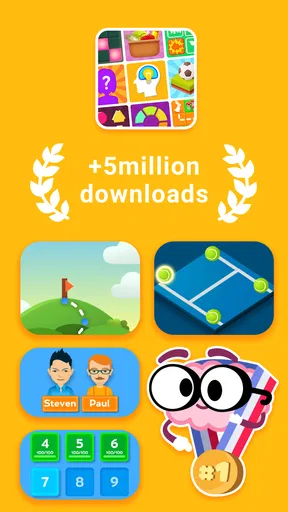
Its broad audience is reflected in the store rating: it holds an average of 4.6 from around 126 thousand ratings, alongside roughly 2.3 thousand written reviews. It has also passed 5 million installs, so this is not an obscure experiment with a tiny audience. Those figures do not replace personal testing, but they do suggest that the straightforward format works for many people looking for casual brain training.
A practical routine instead of random play
I get more from the game when I use it at a consistent moment rather than opening it only when I am bored. A useful routine is a few rounds after lunch, with notifications and other distractions put aside. The goal is not to chase a perfect result every time. I pay attention to whether I am rushing, losing details, or improving my concentration from one session to the next.
One non-obvious benefit is that the format exposes the difference between recognition and recall. In a normal quiz, seeing several answer choices can make a fact feel familiar. Memory challenges are less forgiving: I have to hold the information in mind before the answer becomes obvious. That makes the game useful as a small self-check for attention, especially on days when I feel mentally scattered.
Another practical approach is to play when I am alert, not when I am already tired. A poor result late at night may reflect fatigue rather than memory ability. Treating each attempt as a snapshot of concentration keeps the experience constructive. I would not use a score from this game as a medical measurement or as evidence of cognitive health.
What the update history tells existing players
The current version, 3.6.4.9, shows that the project has continued beyond its original release on August 29, 2018. That is useful context for people who have used it for years: the app is an established title rather than a newly launched memory game. At the same time, a version number alone does not prove that every change will be noticeable during play, so I would judge the update by how smoothly the current build runs on your particular phone.
For existing users, the most important question is not whether the number changed but whether the familiar routine remains dependable. If you already enjoy the exercises, a current installation should be the sensible way to continue, particularly on a device that meets the Android 7.1 minimum. If you are returning after a long break, I would spend a few sessions checking whether the pacing and language still suit you before deciding whether it deserves a regular place in your routine.
The app’s long presence also affects expectations. It is reasonable to expect a mature, focused experience rather than a constantly expanding social platform. I would not choose it because I want a stream of community challenges, elaborate events, or a broad collection of unrelated game modes. Its value is in the narrow activity it offers and in how quickly I can begin.
Where it fits beside ordinary alternatives
Compared with general trivia apps, this game gives memory and attention a more central role. A conventional quiz is often rewarding when I know the answer already, while this title asks me to work with information presented during play. That makes it a better choice for someone who wants the act of remembering to be part of the challenge.
Compared with crossword puzzles or word games, it places less emphasis on spelling, vocabulary, and deduction. Someone who loves building words or solving clues may find those alternatives richer and more satisfying. Compared with meditation apps, this is more active and answer-driven; it does not replace a calming breathing routine. Compared with competitive quiz platforms, it feels less dependent on speed, rankings, or outside knowledge, which can be a relief for players who dislike pressure.
The trade-off is variety. A specialized memory game cannot offer the same range as a large puzzle collection. After repeated sessions, a player who needs constant novelty may move on quickly. I see that as a choice rather than a flaw: the narrower design helps the app remain easy to understand, but it also limits how long it can hold the attention of someone seeking a complete entertainment package.
Small strategies that make the exercises more useful
I would begin by reading the instructions carefully instead of tapping through them. In memory games, a missed rule can look like a memory failure. Once I understand the task, I try to group information mentally rather than repeating every item in isolation. Creating a simple image, sequence, or association can reduce the feeling of holding disconnected details in my head.
I also avoid multitasking. Playing while a video runs in the background or while messages arrive makes the result difficult to interpret. A better workflow is to silence distractions, complete a short session, and then note what caused mistakes: poor attention at the beginning, confusion between similar items, or simply forgetting after a delay. That turns casual play into a more informative personal routine.
A further tip is to alternate the time of day across several sessions. If I always play when fully rested, I learn how I perform under ideal conditions. Trying it once during a normal afternoon break gives a more realistic picture of whether the app helps me refocus in daily life. I would still keep expectations modest; repetition may improve familiarity with the format without producing broad improvements in every kind of memory.
Limitations worth considering before installing
The first limitation is the English-only focus implied by the game’s presentation. It can be a positive feature for English learners, but it is not the best fit for someone who wants memory exercises in another language or who finds reading English tiring. Parents should also consider the player’s reading ability even though the content rating is Everyone.
The second limitation is that casual brain training should not be confused with professional cognitive assessment. I would use the game for engagement, concentration practice, and entertainment. I would not use it to diagnose a problem, track a health condition, or replace advice from a qualified professional. If someone is worried about a real change in memory, a game score is not the right evidence to rely on.
The free price lowers the barrier to trying it, but in-app purchases range from $0.99 to $4.49 per item. That means I would check the purchase prompts carefully and decide in advance whether optional extras are worth paying for. The app is most appealing when the free experience already meets your needs; spending should be a deliberate choice, not something triggered by impatience during play.
There is also a motivational limitation. Because the exercises are designed around memory rather than a large narrative or deep progression system, the initial novelty may fade. I would skip it if I need a story, multiplayer competition, or a strong sense of character development. I would also look elsewhere if my main goal is learning a subject, since remembering game information is not the same as following a structured educational course.
Who should try it, and who should pass
I think it is a good match for adults who want a low-pressure mental activity, older players who prefer clear trivia-style tasks, and English learners who enjoy practicing through short challenges. It can also work for families looking for a calm alternative to reflex-heavy games. The Everyone rating makes it broadly approachable, but the actual fit still depends on reading comfort and patience.
I would be more cautious about recommending it to someone who needs measurable training plans, detailed performance analysis, or specialized exercises for a clinical purpose. It is also not ideal for a player who becomes frustrated by repeating similar tasks or who expects every session to introduce a new mechanic. A broader puzzle app may offer better long-term variety in that case.
For a realistic everyday example, imagine having ten minutes before an appointment. Instead of opening a competitive quiz feed and feeling rushed, you can use that time for a focused memory session, then stop when the appointment begins. If the result is poor, there is no need to treat it as a failure; the session may simply reveal that your attention was divided. That flexibility is one of the reasons I find the game easier to recommend than more demanding alternatives.
What I would watch going forward
For future use, I would pay attention to whether new versions preserve the quick start and readable presentation that make the current experience approachable. Any added content would be most valuable if it expanded the memory challenges without burying them under menus, competition, or unrelated features. The best evolution for this title would keep its focused identity while giving regular players enough fresh material to maintain interest.
I would also watch how the game balances optional purchases with the free experience. Since it is free to download and includes item purchases, clarity matters. A player should be able to understand what is available before deciding to spend. That is especially important for a family-friendly game, where a simple interface should be matched by equally simple purchasing decisions.
Finally, I would look for improvements that help players understand their own habits without pretending to offer medical conclusions. Gentle progress feedback, clearer explanations of mistakes, or better ways to vary practice could make repeat sessions more meaningful. Those changes would support the game’s purpose while respecting its limits.
My overall view is positive but measured. Train your Brain. Memory Games is a focused, free trivia game for exercising recall in English, not a complete brain-health program and not a replacement for a full puzzle collection. Senior Games has kept the concept accessible, and the current build remains appealing when I want a short activity with a clear mental task.
The best reason to install it is its low-pressure memory loop: it gives me something specific to concentrate on without demanding a long commitment. I would try it if you enjoy short challenges, are comfortable with English, and can accept a modest range of activities. I would skip it if you want advanced analytics, rich competitive features, or a structured course. Used with realistic expectations, it is an easy game to fit into an ordinary day and a pleasant way to make a short break feel more intentional.
Verdict
Strengths of Train your Brain. Memory Games
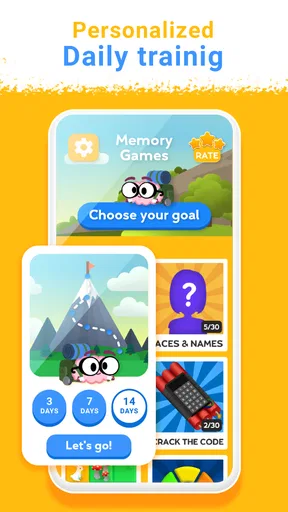
- Short daily exercises make it easy to build a consistent routine.
- Several memory challenges help keep practice varied and engaging.
- Simple controls make the games accessible to most age groups.
- Progress tracking can encourage users to continue practicing regularly.
- Useful for filling short breaks without requiring an internet connection.
Limitations of Train your Brain. Memory Games
- Some challenges may feel repetitive after extended use.
- Difficulty may not adapt perfectly to every player's skill level.
- Ads can interrupt the experience, depending on the app version.
- Results are not a reliable measure of real-world memory ability.
- Advanced features may require an in-app purchase or subscription.
Other Releases by Senior Games
View All


Similar Picks in This Category
View All
Millionaire 2026 Quiz & Trivia
Quiz & Trivia Games by Submarine Apps4.5

Brain Test 2: Tricky Stories
Unico Studio4.7

Trivia Crack: Brain Quiz Games
etermax4.4

QuizzLand. Quiz & Trivia game
Quiz & Trivia Games by Mno Go Apps4.8

Brain Test: Tricky Puzzles
Unico Studio4.7

Logo Quiz
bubble quiz games4.5
Frequently Asked Questions
What is Train your Brain. Memory Games?
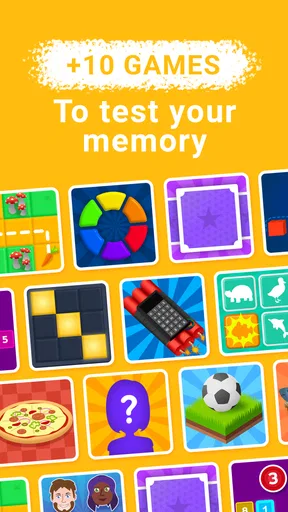
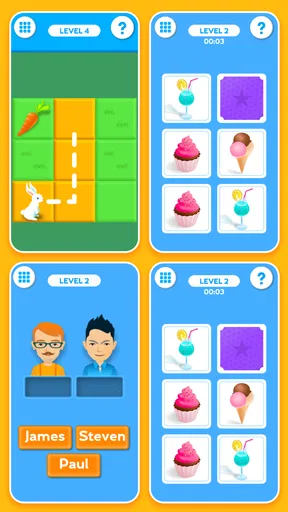
Train your Brain. Memory Games is a collection of short exercises designed to challenge memory, concentration, attention, and mental speed. The app typically presents visual matching tasks, sequence challenges, recall tests, and other brain-training activities in a simple format. Its sessions are suitable for quick daily practice, whether you want casual entertainment or a structured way to keep your mind active.
How do you play the memory games in the app?
Gameplay is generally based on observing information, remembering it, and responding correctly within a limited time or number of attempts. Depending on the exercise, you may need to match cards, remember positions, reproduce patterns, or identify changes on the screen. The difficulty can increase as you progress, so the games remain challenging without requiring complicated controls or previous gaming experience.
Is Train your Brain. Memory Games suitable for children and adults?
The app can be appropriate for a wide range of ages because its activities use straightforward rules and do not require advanced reading or gaming skills. However, the recommended age, advertising content, and privacy conditions may vary by version and platform. Parents should review the store listing and in-app settings before allowing children to use it, especially if purchases or online features are available.
Does the app work without an internet connection?
Many individual brain-training exercises may be playable offline once the app has been installed, which makes it convenient for short sessions while traveling or when mobile data is unavailable. Nevertheless, certain functions—such as advertisements, progress synchronization, updates, leaderboards, or optional online content—may require an internet connection. It is best to test the specific games you want to use before relying on offline access.
Is Train your Brain. Memory Games free to download and use?
The application may be available as a free download, but free access can include advertisements, locked activities, limitations on daily play, or optional in-app purchases. The exact model depends on the Android or iOS version. Before downloading, check the current store page for subscription details, purchase prices, cancellation terms, and the permissions requested, so there are no surprises during regular use.
Play our best games!


